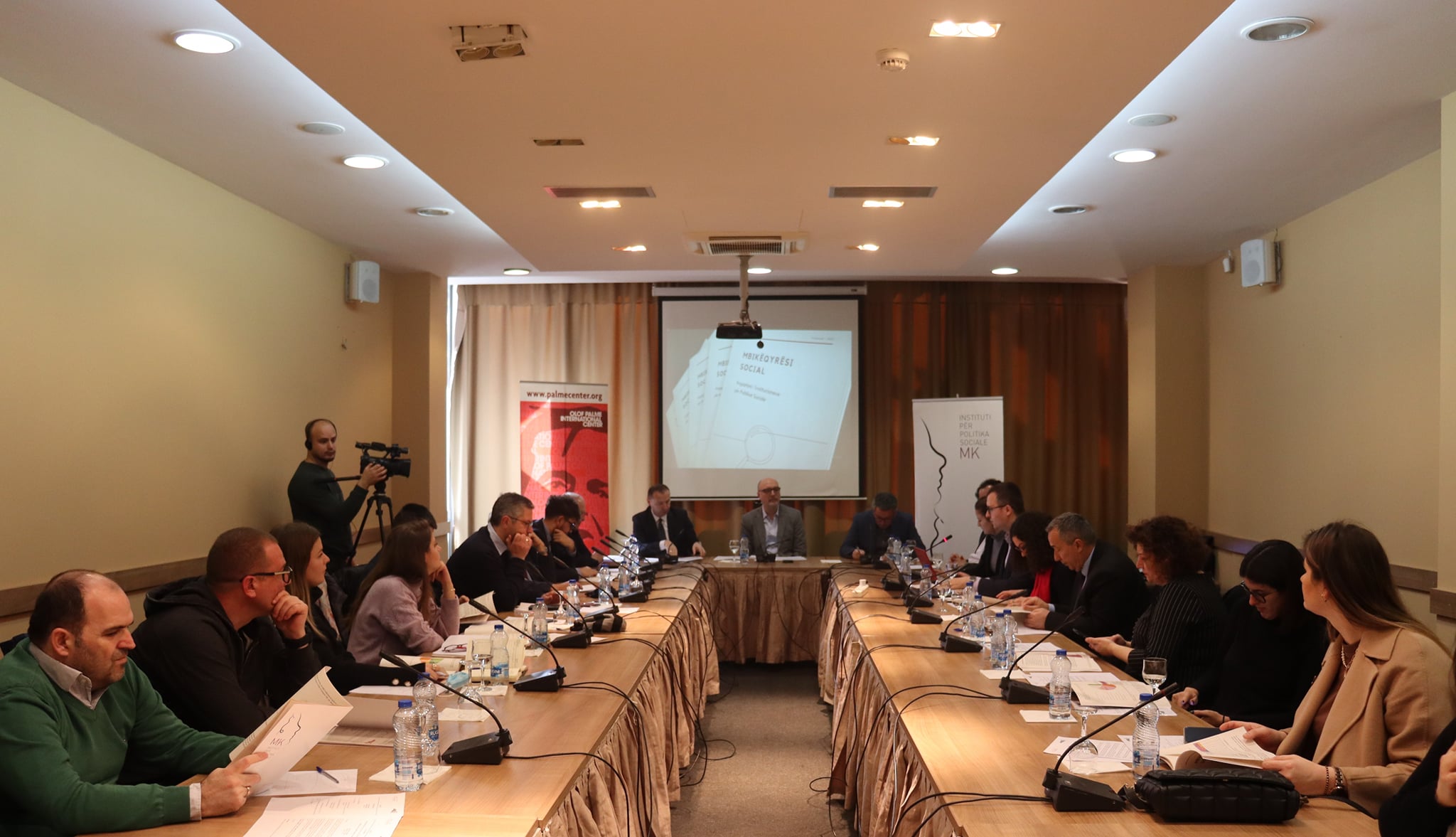
The Musine Kokalari Institute for Social Policies held today in Prishtina the roundtable “Social Policies in Institutions – Social Oversight: MPs’ Engagement with Social Policies.” The roundtable, which discussed social policies and the importance of the Welfare State for the Republic of Kosovo, was attended by MPs and representatives of civil society, who agreed that the discussion on social dialogue should be energized and that more attention should be given to the importance of the Welfare State. The panel included Mr. Armend Zemaj, MP and Deputy Chair of the Committee on Health and Social Welfare; Mr. Artan Mustafa, social policy researcher and analyst; and Mr. Visar Ymeri, Executive Director of the Musine Kokalari Institute for Social Policies. On their part, Ms. Fjolla Muçaj and Mr. Naim Jakaj from IPS Musine Kokalari presented the collected and analyzed data from their report: “Social Oversight for 2021.” “Although social welfare remains undefined, throughout last year we did not even manage to discuss it—not for the fault of the MPs.
“Kosovo must initiate social dialogue and social reform,” declared Mr. Armend Zemaj. Mentioning the child and unemployed mother allowances as important initiatives within social policies, Mr. Artan Mustafa raised the need to reform the welfare state by shifting the focus toward the working-age population in order to balance these policies from an intergenerational perspective. “Kosovo needs social insurance that would cover a wider range of social needs and thereby increase the competitiveness of our citizenship,” he said, emphasizing social security as one of the causes of emigration.
MP Shemsedin Dreshaj, from the Committee on Health and Social Welfare, stated that the frequent changes of governments have caused problems in the social field, as policies have been inconsistent and often left incomplete. He criticized the current government for not taking into account the work of previous governments in this regard and emphasized the necessity for a complete reform of social schemes. Dreshaj added that the fact that the current government has postponed these laws until the end of the year risks delaying their discussion and approval until next year, which would subsequently delay their implementation until 2024. “Kosovo lacks strategic documents for Health or Social Welfare,” stated MP Burim Meta, highlighting the need to strengthen the labor component in the social aspect within the Committee on Health and Social Welfare.
In closing the roundtable, Mr. Visar Ymeri emphasized the importance of a broader and more comprehensive discussion on the social state model that Kosovo needs and which would be more feasible to implement. “The fundamental determination is whether we focus on working conditions (wages, etc.) and through them ensure greater equality in society, or whether we leave the labor market to the principle of freedom and then cover the gaps through social schemes. Both of these models have their pros and cons. The welfare state is built within the framework of a long-term vision for sustainable economic and social development and should not be viewed either as divided or outside of it,” he concluded. The roundtable “Social Policies in Institutions – Social Oversight: MPs’ Engagement with Social Policies” was supported by the Olof Palme International Center – Prishtina.
February 28, 2022