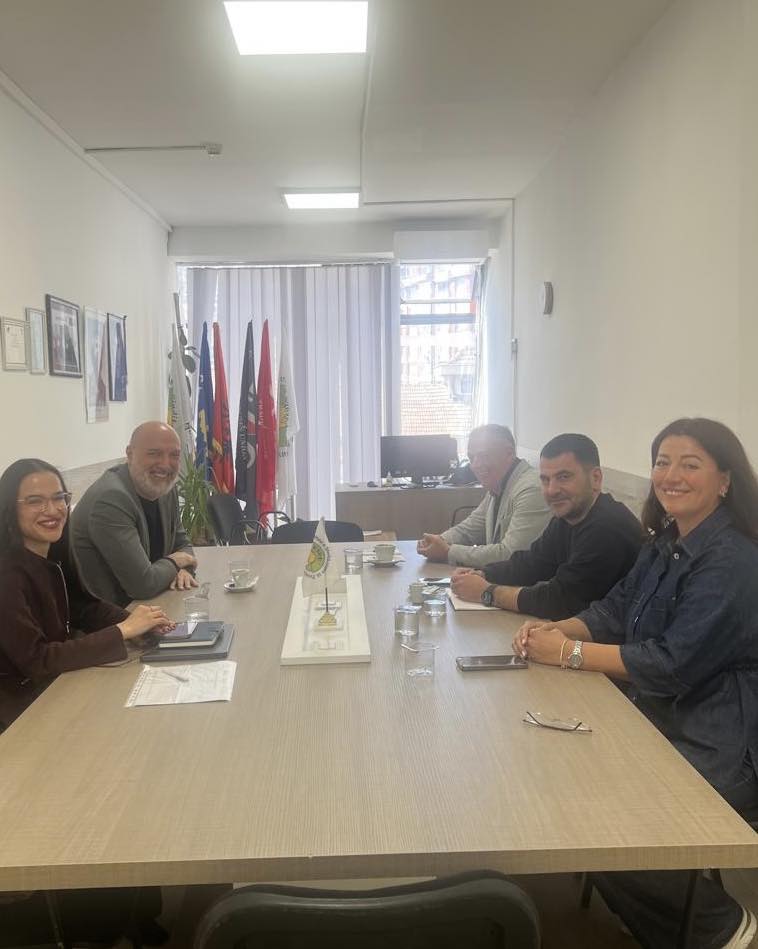
The Musine Kokalari Institute for Social Policy held a meeting with representatives of the Federation of Independent Trade Unions of Elektrokosova, where the work, organizational structure, and operational practices of the union were presented.
During the meeting, it was highlighted that the union represents around 2,100 workers, of whom approximately 1,100 are active members. Its structure includes seven associations and regional centers with their own leadership bodies.
It was also emphasized that relations with management are functional, reflecting a recognition of the union’s role by the owners. In this context, concrete benefits have been achieved for workers, including overtime compensation, regular bonuses, full health insurance coverage, food allowances, and continuous improvements in working conditions.
Representatives of the union noted that they provide direct support to members through legal counseling, representation in disciplinary committees, and participation in various decision-making processes.
However, several key challenges were identified. One of them is the low level of awareness among non-member workers, who often do not understand the importance of trade union organization. This also affects internal dynamics, as benefits are often extended to non-members.
Another challenge relates to youth inclusion, where the need to increase awareness and public communication about the role of trade unions was emphasized. In this regard, the lack of activities such as workshops and limited media engagement were identified as areas for improvement.
On the other hand, the active role of women in the union was highlighted, including the functioning of the Women’s Forum with around 120 members, as well as their involvement in organizational and decision-making processes.
During the discussion, internal mechanisms for maintaining the integrity of the union were also mentioned, including statutory rules for candidacy and engagement, as well as the implementation of an approved code of ethics. The importance of preventing external interference and ensuring the independent functioning of the union was also emphasized.
The meeting served to identify concrete opportunities for cooperation between the Institute and the union, particularly in increasing awareness, empowering youth, and strengthening the union’s public presence.
(This activity is supported by the Kosovo Civil Society Foundation (KCSF) program “EJA Kosovo”, co-funded by the Swiss Agency for Development and Cooperation (SDC) and Sweden.)