Kosovo records the lowest labor market participation in the region, with an employment rate of 38.6% and an activity rate of 43.2%. In comparison, Albania, Montenegro, and Serbia have more active labor markets and higher employment levels. North Macedonia and the Federation of Bosnia and Herzegovina register activity rates below 50%, but with slower dynamics. Meanwhile, Republika Srpska in Bosnia and Herzegovina shows a higher employment rate (57.7%) despite having a lower activity level.
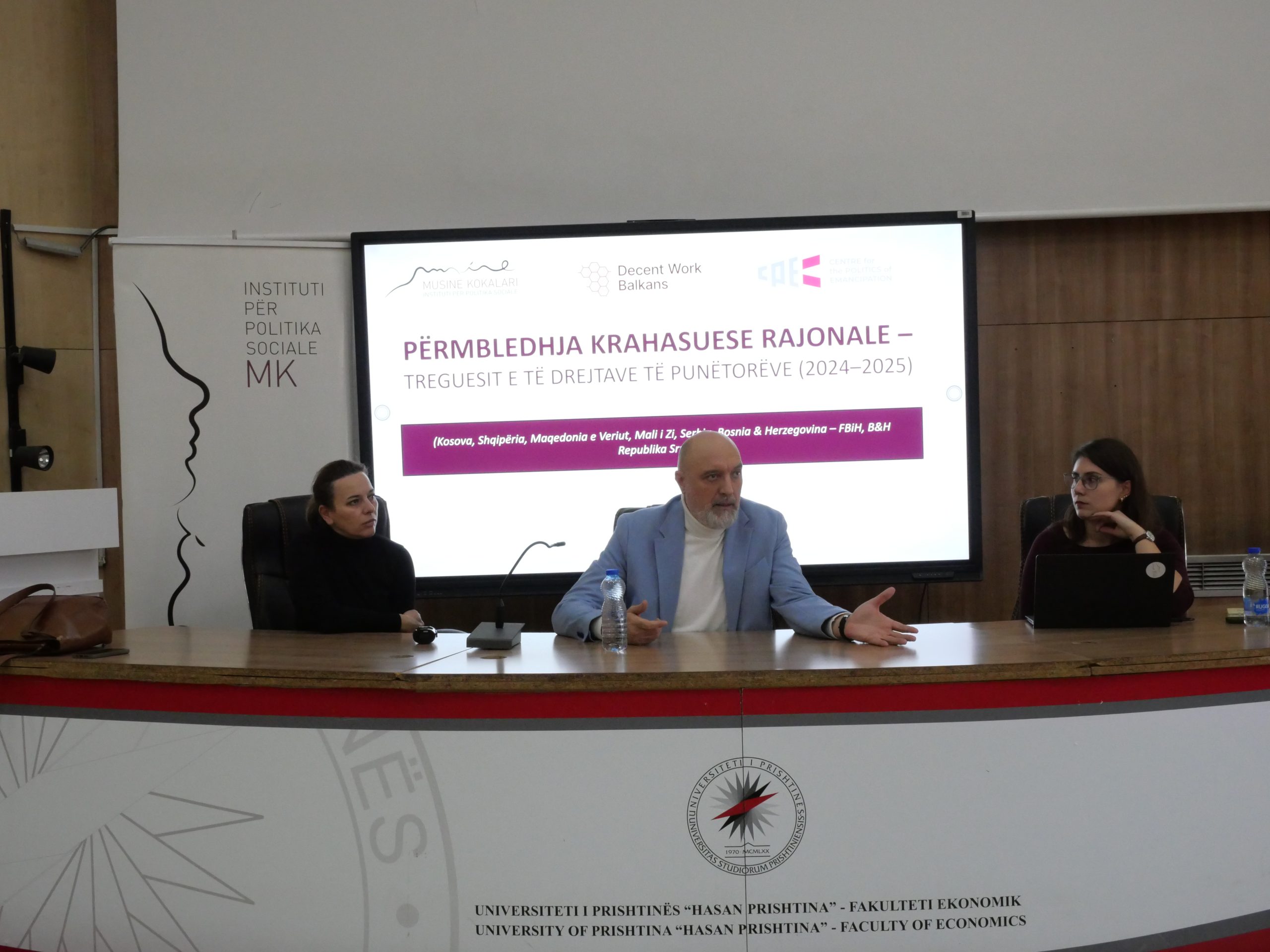
These findings were presented at the Faculty of Economics of the University of Prishtina by the Musine Kokalari Institute for Social Policy, which published the first comparative analysis for 2024–2025 on the quality of workers’ rights in Kosovo and across the region. The event was organized within the project “Activities for Promoting and Advancing Decent Work in Western Balkans Countries,” supported by the European Fund for the Balkans (EFB), part of the Network of European Foundations.
Professor Adriana Gashi, from the Faculty of Economics, in her opening remarks emphasized the importance of addressing workers’ issues from a regional perspective. Meanwhile, Drenusha Canolli, Program Director at the Musine Kokalari Institute for Social Policy, noted that the report includes data from Kosovo, Albania, North Macedonia, Serbia, Bosnia and Herzegovina, and Montenegro.
The results show that most countries in the region face low wages, long working hours, insufficient workplace safety, and weak social dialogue. As a result, workers remain unprotected, and violations of their rights often go unaddressed by the responsible institutions.
Regarding the minimum wage and the cost of living, the basic living basket is not covered in any country in the region, and in some cases coverage falls below 40%. In most countries, the minimum wage fails to cover even half of the real cost of living. Kosovo has the lowest minimum wage in the region at €342, while in Albania it is €420 (2025), in North Macedonia €392, in Serbia €460, in Republika Srpska €460, in the Federation of Bosnia and Herzegovina €511, and Montenegro has the highest minimum wage at €550, stated Visar Ymeri, Executive Director of the Musine Kokalari Institute for Social Policy.
The union living basket is not covered in any regional country. As for working hours and overwork, most countries report exceeding legal limits, especially in construction, manufacturing, and services. Kosovo stands out negatively as the only country where overtime work is not paid at an increased rate, despite legal harmonization with European standards.
Data indicate a high level of workplace risk and a lack of inspection resources across the region. Serbia records the highest number of fatal workplace accidents, with over 50 deaths per year. North Macedonia reports 17 cases, the Federation of Bosnia and Herzegovina 9 deaths and 438 serious injuries, Republika Srpska 10 deaths and 97 serious injuries, while Kosovo registered 7 fatalities in 2024.
Regional data also show that women remain underrepresented and underpaid in the labor market. Kosovo has one of the lowest female participation rates in the region at 34.7%, while in the Federation of Bosnia and Herzegovina only 30.6% of women are employed. Republika Srpska has seen gradual improvement, but the gender gap remains significant. In this regard, North Macedonia performs better, with a gender gap of 16.5%. For Albania and Montenegro, the situation is assessed as average, but complete comparative data are lacking.
A key indicator in discussing gender inequality remains the gender pay gap. In Kosovo, this gap reaches 18.6%, while in Serbia it varies between 13–14%, and in North Macedonia it stands at around 10%.
The report aims to push public institutions, trade unions, employers, and civil society organizations to elevate decent work standards in Kosovo and across the region. This marks the second year that the Musine Kokalari Institute for Social Policy and the Center for Policy Emancipation, within the Decent Work Balkans platform and in cooperation with partner organizations from across the region, produce an updated comparative analysis on labor rights and socio-economic conditions in the Western Balkans.


