By Darko Dimitrijević
The end of the three-month transitional period has exposed the gap between the promise of integration and the reality of administrative exclusion that many Kosovo Serbs face in accessing identity documents.
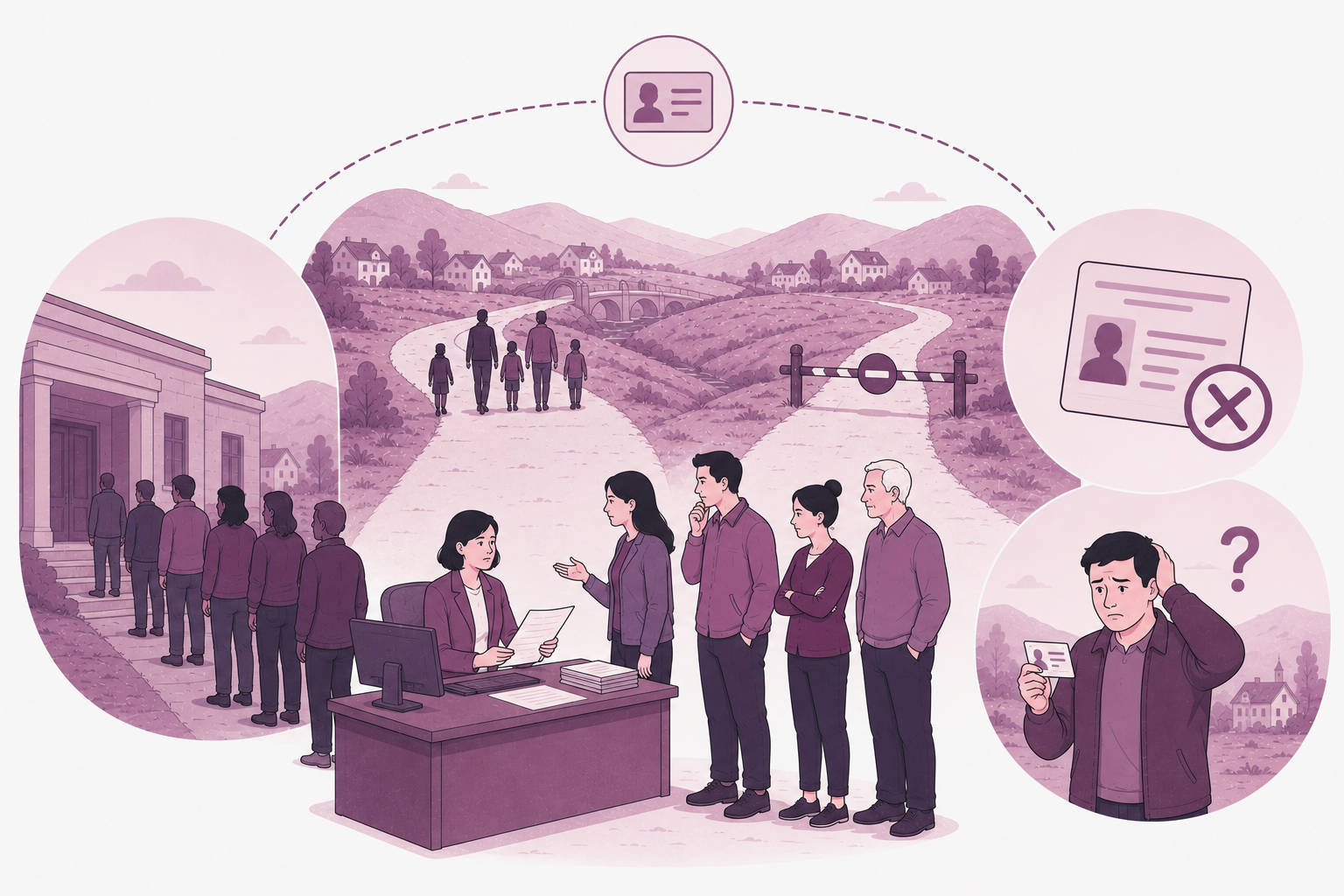
The three-month transitional period for the exchange of documents in Kosovo has officially come to an end. While the political elites in Pristina and certain international officials will likely will likely portray this process as yet another success on the path toward full “integration” and the establishment of the rule of law, the reality we live on the ground paints a completely different, devastating picture. Behind the bureaucratic press releases lie thousands of confused, deceived, and legally invisible citizens. The result at public service counters is crystal clear: the administrative wall erected in front of the Serb community was so high that, for instance, in Peja and its surroundings, our investigative reporting could not track down a single case of a successfully resolved request.
The issue of personal documents has never been, nor can it ever be, a purely technical or administrative matter. It is a fundamental question of human rights, the right to exist, freedom of movement, healthcare, work, education, and a dignified life. However, the three-month window, which was supposedly opened with the goal of easing people’s lives and resolving long-standing issues, transformed in practice into a rigid, discriminatory administrative labyrinth. Instead of inclusion, we received institutional rejection.
One of the most alarming consequences of this process, which was explicitly exposed during our recent public debate on this topic, is the creation of an entirely new generation of isolated, legally shackled young people. Youths who were born outside of Kosovo, but who live, study, and want to build their future here, have been left in a complete legal vacuum following the expiration of this deadline. Due to administrative barriers, they can no longer use the crossings in the south or move normally within the system. They are condemned exclusively to the Jarinje and Brnjak administrative crossings in the north. The system, through its own inflexibility, inertia, or conscious intent, has ghettoized them and restricted their elementary freedom of movement.
As an independent media outlet conducting deep journalistic investigations into this system, our editorial team has meticulously documented the chronology of this administrative failure. The process itself was delayed from the very start, which automatically left citizens with significantly less time to collect an overwhelming amount of documentation. On the ground, we were met with absolute chaos, both in the contradictory interpretations of the regulations and in the obvious lack of training and information among municipal clerks regarding what the procedure was even supposed to look like.
Our reporting detected extreme inconsistencies in practice from one municipality to another. Citizens overnight became hostages to the personal will, mood, or whim of individual clerks behind the glass. While there were bright examples of workers who performed their jobs professionally and tried to help, we also documented flagrant examples of institutional obstruction. We have verified cases where applicants, in the very final days of the transition period, were turned away from the window up to four times with the claim that they did not meet the requirements simply because they possessed a Serbian ID card issued for a city in Kosovo. The absurdity lies in the fact that the entire three-month transitional period was legally designed precisely for those people, to allow them to exchange those exact documents. When an institution does not understand its own decisions, the citizen always pays the price.
A deeper look into the legal framework reveals an even more perfidious problem that goes beyond poor practices at the administrative counters. In parallel with this process, the new Law on Kosovo Citizenship introduces elements of deep, The experience of Slađana Miletić.indirect discrimination. Namely, members of the diaspora who voluntarily renounced their Kosovo citizenship in the past now enjoy a highly facilitated, rapid, and simplified procedure to reclaim it under the new rules. On the other hand, Kosovo Serbs who have a legally guaranteed right to citizenship and documents, but were never able to materialize that right due to the specific political, historical, and security context over the last quarter of a century, are now factually losing that right permanently. The text of the law on paper may appear ethnically neutral, but when applied to the specific local context, it creates a profound imbalance where Kosovo Serbs are placed at a drastic disadvantage compared to the Albanian diaspora living abroad.
Yet, dry legal analyses and statistics pale in comparison to the real human fates that stand behind every single rejected application. The experience of Slađana Miletić, a mother who has been fighting a futile battle with the administration for months to secure personal documents for her daughter, represents a mirror image of the entire system. Her daughter was rejected because she was born in Kragujevac. When they finally gathered all the papers and submitted the application, it was rejected due to a document on family union issued by, believe it or not, the municipal clerk himself. That clerk entered the child’s unique identification number from Serbia into the form, only for another control body to later reject the application, claiming that the number should not be there. Instead of the administration taking responsibility for the error of its own staff who filled out the document, the family was sent back to the starting point, with a cynical request to gather absolutely all the papers again and enter a new circle of uncertainty.
What does this bureaucratic “starting over” actually cost?? For just one child, the costs of obtaining documents in central Serbia, certifying them with international apostille stamps, the services of public notars, and multiple trips to Kragujevac and back amount to around 500 euros. In our socio-economic reality, this is an enormous, and for many families completely unachievable, amount of money. These are funds that families must tear out of their household budgets, fully aware that no one, neither in the municipality nor in the ministry, guarantees that the final outcome won’t be the exact same stamp reading: rejected!
This quiet, bureaucratic calvary must not pass in silence. As journalists, we will not stop reporting on this, and we join the rightful appeals to local institutions and international representatives in Kosovo to react urgently. It is necessary to extend the deadlines, drastically simplify the procedures, introduce more flexible regimes, and, above all, ensure rigorous monitoring of the clerks’ work so that practices can be unified.
International diplomats, who regularly and declaratively insist on the rule of law and the protection of non-majority communities in their public appearances, must not close their eyes to the fact that the basic human right to identity and documents is being charged hundreds of euros to citizens, only to end in systemic and groundless rejection. If the recommendations from the ground are not urgently adopted, and if the clerk windows remain places of political and personal scores being settled against the rights of citizens, the right of the Serb community to obtain identity documents will remain just a dead letter on paper, an unattainable privilege reserved only for those who have enough money, luck, and patience to survive administrative persecution.
(The author is the Editor-in-Chief and a journalist at Radio Goraždevac in Goraždevac, Peja/Peć Municipality, Kosovo)
This op-ed was written as part of the project ‘Promoting Political Dialogue on Interethnic and Social Cohesion’, supported by the National Endowment for Democracy (NED)