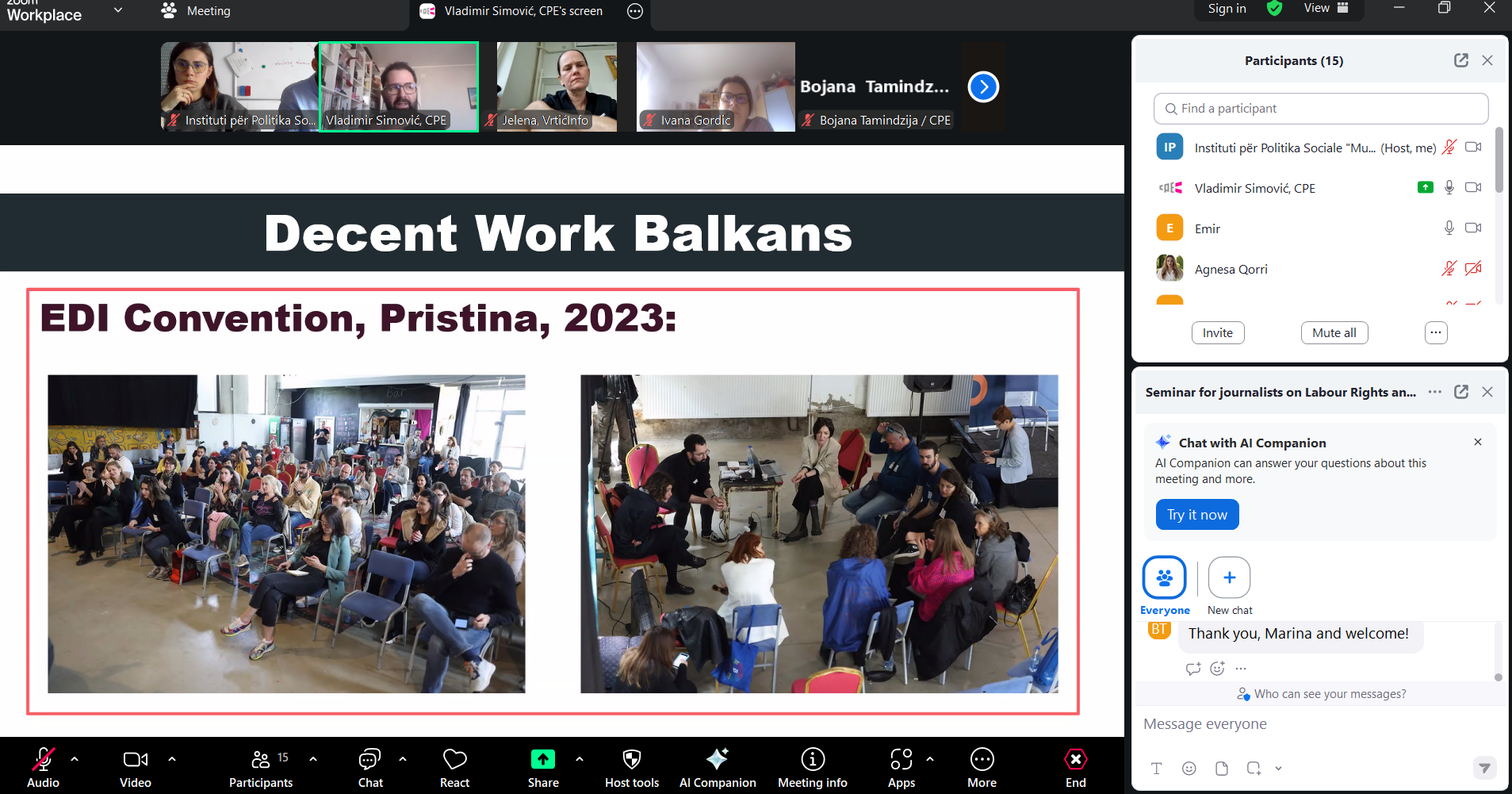
The Musine Kokalari Institute for Social Policy, in collaboration with Centar za Politiku Emancipacije (CPE), organized a two-day seminar for journalists focused on labour rights and economic justice.
The seminar was held online and gathered young journalists and media professionals from Kosovo, Serbia, Montenegro, North Macedonia, Bosnia and Herzegovina, and Albania. Its aim was to strengthen their capacities for ethical and investigative reporting on labour and economic issues.
The program covered key topics such as the concepts and legal frameworks of decent work and workers’ rights; socio-economic challenges in post-transition countries; the use of Decent Work Balkans (DWB) data tools for investigative journalism; ethical reporting and narrative techniques; due diligence legislation; and corporate accountability.
In the first session, “Mapping the Reality of Decent Work in the Western Balkans”, lecturers Visar Ymeri and Vladimir Simović provided an overview of socio-economic challenges affecting workers’ rights. Drawing on two years of DWB fact-sheets, they presented practical tools for evidence-based research and to better understand regional dynamics of decent work.
The second part of the first day focused on ethics, narratives, and workers’ stories, led by journalist Eraldin Fazliu from KTV, emphasizing the creation of ethical and powerful storytelling that addresses structural injustices.
The second day began with the session “Global Supply Chains and Corporate Accountability”, led by Bojana Tamindžija, which analyzed the state of workers’ rights in global supply chains and the impact of multinational corporations on labour standards and economic justice.
The seminar concluded with a lecture by investigative journalist Saša Dragojlo from BIRN, titled “Journalism and Labour Rights: Between Testimony and Fact”, which focused on balancing field testimonies with verified facts, highlighting the critical role of journalism in protecting workers’ rights.
This seminar represented an important step in strengthening critical journalism in the region and enhancing professional capacities for reporting on labour issues. It created opportunities for collaboration among journalists from different Western Balkan countries and highlighted the need for coordinated approaches to socio-economic challenges affecting workers.
The activity was organized under the project “Activities for Promoting and Advancing Decent Work in Western Balkans Countries”, supported by the European Fund for the Balkans (EFB), part of the European Foundations Network.


