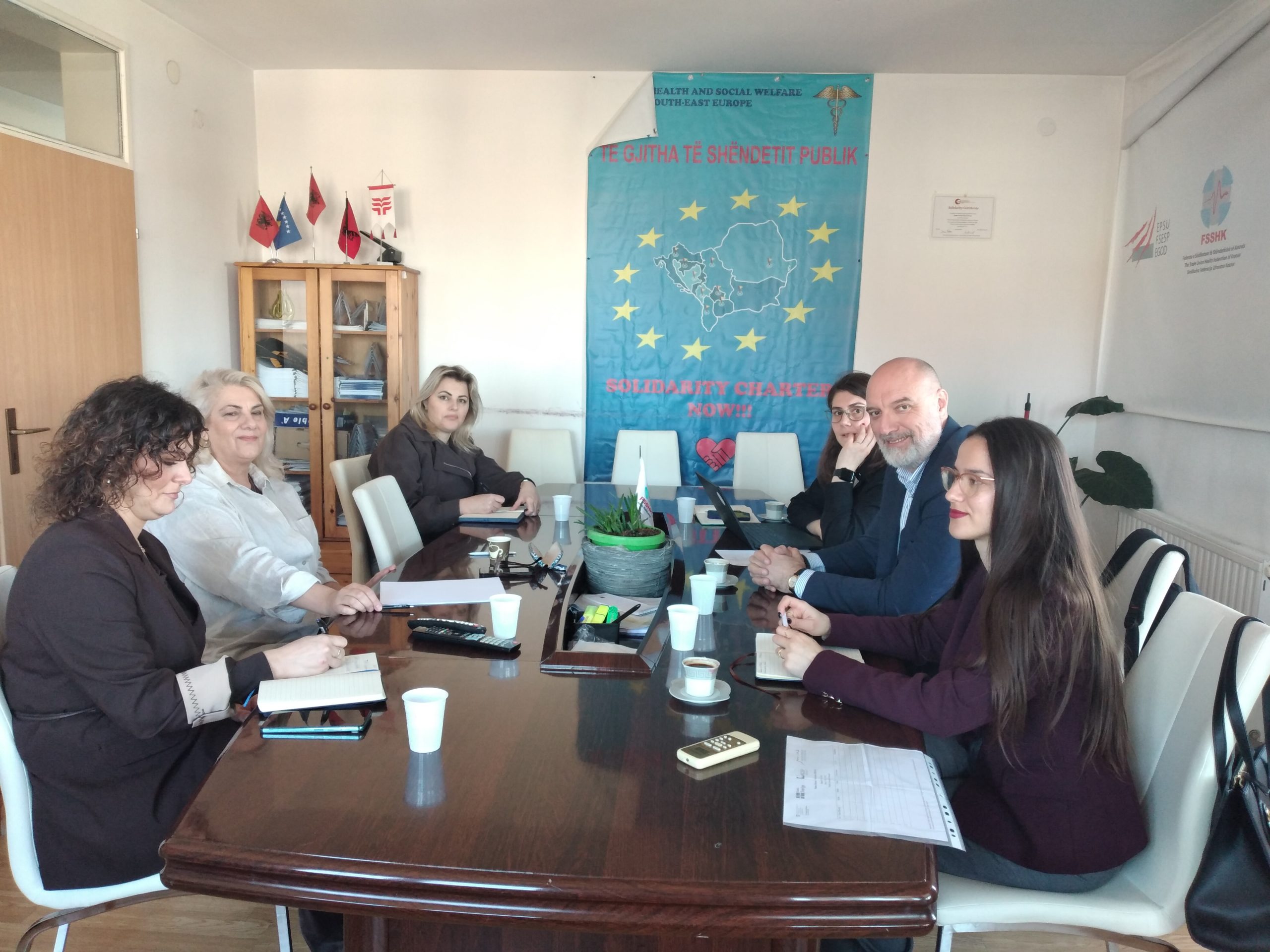
The Musine Kokalari Institute for Social Policy held a meeting on Tuesday with the Federation of Health Trade Unions of Kosovo, where the current situation in the sector and the challenges faced by healthcare workers were discussed.
Representatives of the Federation emphasized that social dialogue with institutions remains limited and non-functional. According to them, communication with the government has not produced concrete results. They also raised concerns about interference in the internal functioning of trade unions and pressure on union leadership.
According to the Federation, the Law on Public Officials has negatively affected both the position of workers and the functioning of trade union organization. Cases of violations of trade union rights and a lack of institutional support were also highlighted.
Declining membership was identified as a key concern. Federation representatives linked this to economic factors and a lack of active engagement, stressing the need to improve communication and raise awareness about the importance of trade union organization.
In this context, concrete measures to increase membership were discussed, including the use of public communication and the establishment of mechanisms for identifying and managing members.
Federation representatives underlined that working conditions remain difficult. Extended working hours and high workloads are particularly prevalent in high-risk departments such as dialysis, where work is carried out at high intensity with limited breaks.
The meeting also addressed the need to develop a collective agreement as a mechanism to regulate labor relations and protect workers’ rights in the healthcare sector.
Representatives of the Musine Kokalari Institute for Social Policy highlighted the importance of strengthening the organizational capacities of trade unions and expressed their readiness to contribute expertise to this process.
Additionally, the need for broader cooperation among trade unions was discussed, including the possibility of establishing a joint union in the public sector.
The digitalization of trade union processes was identified as a challenge, particularly in relation to the e-Kosova platform, where, according to participants, there is a lack of effective membership management by the unions themselves.
The meeting served to identify key challenges and discuss potential steps to strengthen the role of trade unions and improve working conditions in the healthcare sector.
(This activity is supported by the Kosovo Civil Society Foundation (KCSF) program “EJA Kosovo”, co-funded by the Swiss Agency for Development and Cooperation (SDC) and Sweden.)