By: Jelena Durlević*
Which is stronger – that which separates us or that which we live by?
In divided societies such as Kosovo, which has long been burdened with ethnic divisions, the answer often comes from everyday life. When farmers sell products together, when traders collaborate across ethnic boundaries, and when local communities work towards common interests, trust between people of different ethnicities is built at an unparalleled rate than through political agreements.
The municipality of Štrpce is a good example of this topic because it represents an environment in which people of different nationalities, cultures and traditions live. Over the years, different historical circumstances have led to the creation of certain ethnic divisions and mutual distrust among communities.
However, everyday life shows that there are areas where cooperation can be stronger than differences. One of the most important such areas is the economy. When people work together, generate income, develop their businesses and improve their quality of life, ethnic differences often become less important than the common interest.
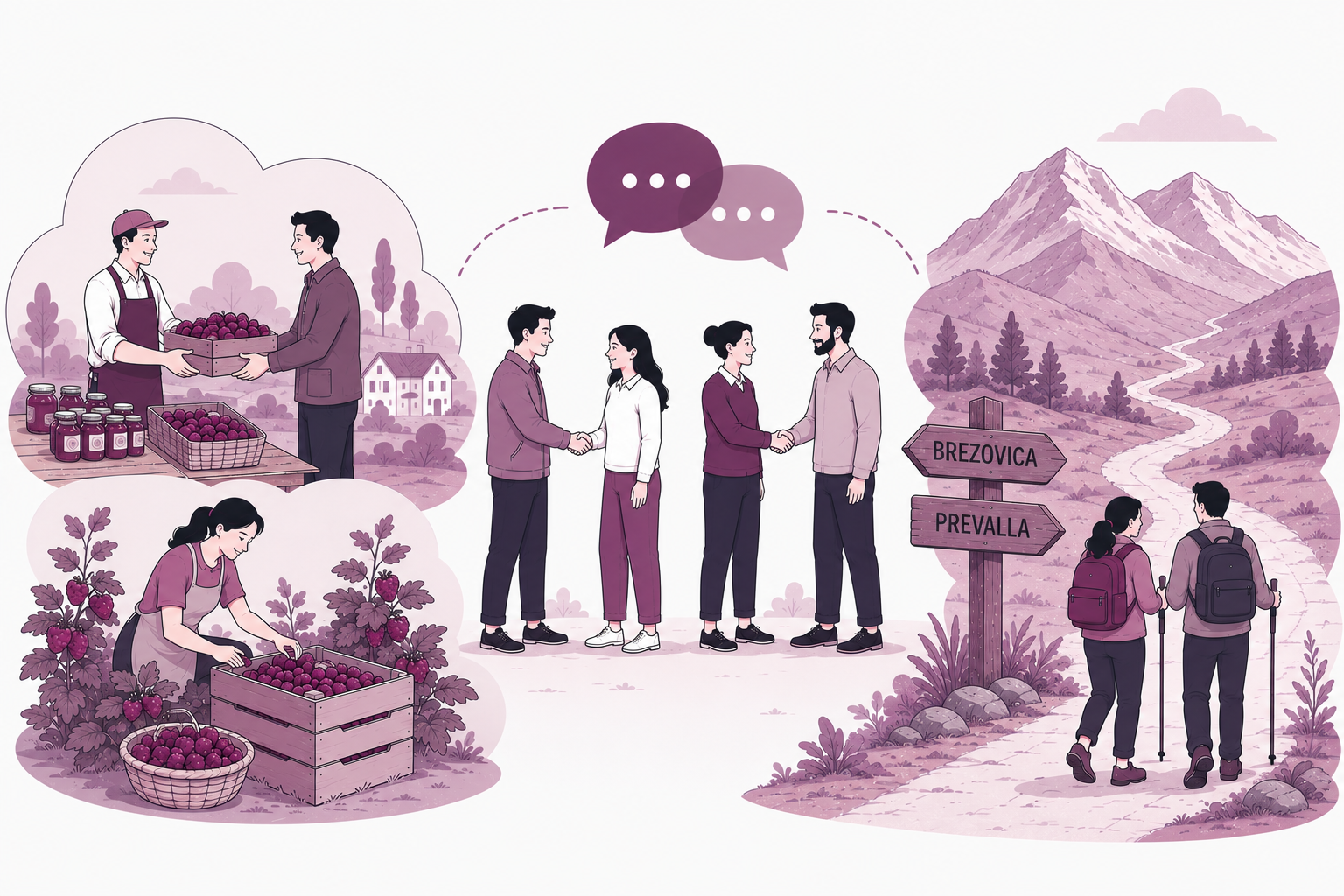
That is why it can be said that economic cooperation has the potential to overcome ethnic divisions in the municipality of Štrpce. The famous Brezovica ski center attracts visitors from different parts of the region, while tourism is one of the most important industries that can connect people regardless of their nationality. The owners of hotels, restaurants, shops, private accommodation and other service activities have a common goal – to provide the best possible service, attract as many tourists as possible and earn better earnings.
In this process, in addition to catering establishments collaborating with various suppliers and partners, they also employ workers, with expertise and quality of work much more important than ethnicity. One example of such business is the hotel “Brezovica”, where employees from the Serbian and Albanian communities work together. In the workplace, people cooperate on a daily basis, solve problems and achieve common goals, and such cooperation contributes to mutual acquaintance and reduction of stereotypes. When someone works with colleagues of another nationality on a daily basis, it is easier to see that there are many more similarities between them than differences.
In addition to tourism, agriculture and livestock farming play a significant role in the economic development of the municipality of Štrpce. Many residents of Štrpce are engaged in the cultivation of raspberries and other fruits and vegetables, but also in the production of milk, the famous Šar cheese, honey and other products.
Agricultural producers often face similar problems, regardless of ethnic and other differences, such as high production costs, the need for a better market, insufficient opportunities for product placement and lack of modern equipment. In order to overcome these challenges, there is a certain level of interethnic economic cooperation in Štrpce. One of the most concrete examples is the partnership between a Serb and an Albanian at the market in Štrpce. Novica Marinković and Bekim Maliqi ran a business and a point of sale together every Thursday for years, and they themselves pointed out that their ethnicity was not an obstacle to cooperation.
This shows that when people from different communities come together to market, share experiences and help each other, they increase their chances of success, while economic interest becomes more important than prejudice and division. Another example that supports this claim is the cooperation regarding the purchase of raspberries in Štrpce. Namely, raspberry growers from the Serbian community sell their products to refrigerator holders from the Albanian community and vice versa.
At the same time, many young people from different communities in the territory of the municipality of Štrpce face the same challenges: unemployment, lack of opportunities for professional development and a desire for a better future. Through collaborative projects, trainings, and entrepreneurial initiatives, they can develop business ideas that benefit the entire community. When young people cooperate to achieve economic goals, they create new friendships and build relationships based on mutual respect. In this way, they become an example that cooperation can be more successful than division.
When people depend on each other through business activities, their willingness to resolve disagreements peacefully increases. The success of one company often benefits other business entities, which fosters a common interest in maintaining good interpersonal relationships. In such an environment, the space for conflicts is reduced, and the possibility for joint development is increased.
If we go beyond the municipality of Štrpce, one of the most prominent examples of interethnic economic cooperation is the factory “Vipa” from Vučitrn, that is, the cooperation of farmers of Serbian nationality and the owners of the factory of Albanian nationality. Of course, economic cooperation alone cannot completely eliminate all ethnic divisions. This requires time, education, mutual respect and the support of institutions. Nevertheless, it can be an important step towards building trust between people.
When local residents see concrete benefits from collaboration, they find it easier to embrace the idea of working together, and working together yields better results than isolation and division. Institutions, schools, NGOs and local self-government can contribute to this process by supporting joint economic projects.
Economic development is one of the most important factors for building better relationships between people, and the example of Štrpce shows that economic cooperation can be a strong bridge between different communities. When people share common interests and work towards common goals, it is easier to overcome prejudices and build mutual trust. Tourism, agriculture and youth entrepreneurship are areas in which cooperation can already bring positive results today.
That is why economic cooperation is an important path to a more stable, successful and connected future for all citizens of the municipality of Štrpce.
*Jelena Durlević graduated from the School of Economics and cooperates with the NGO ‘Strong Start’ from Štrpce.
(This op-ed was written as part of the project ‘Promoting Political Dialogue on Interethnic and Social Cohesion’, supported by the National Endowment for Democracy (NED)).